



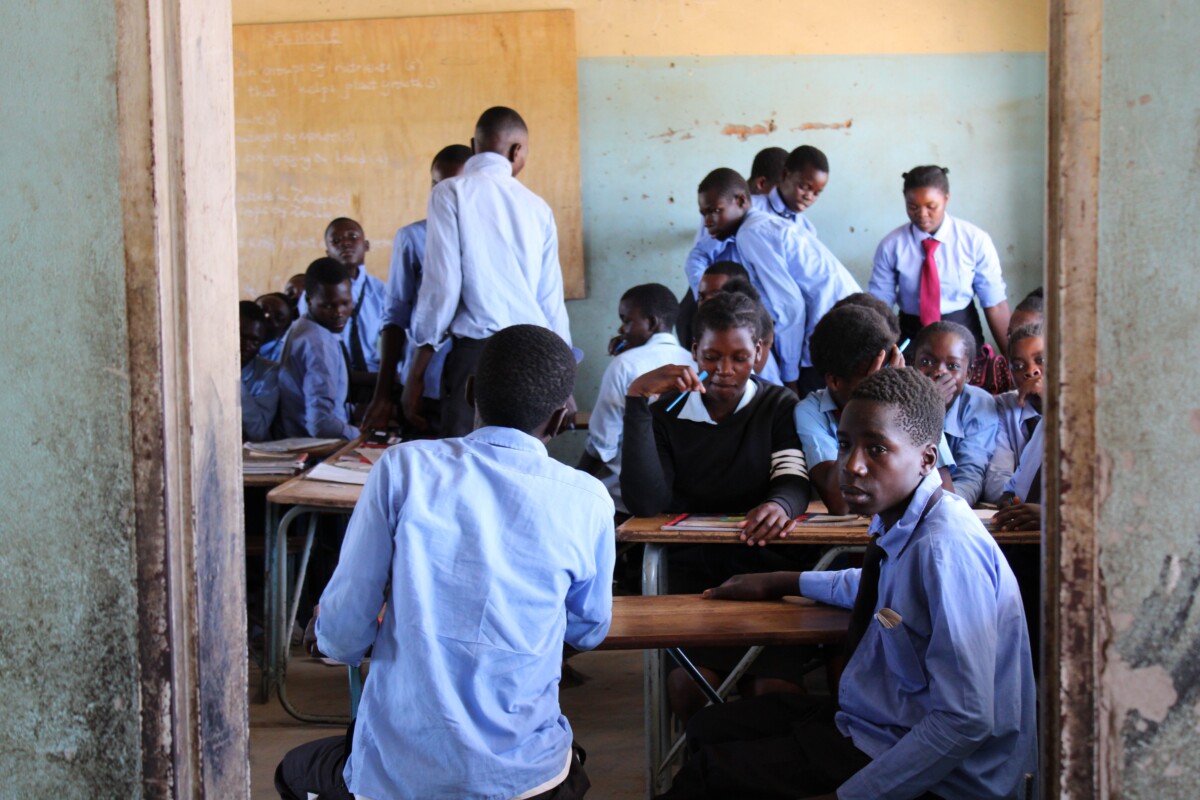
Original content from Hear the World Foundation webinar with Dr. Frank Otieno Odhiambo, researcher at Precision Development in Nairobi, Kenya
Every day, foundations, ministries, and schools across sub-Saharan Africa make decisions about where to invest scarce resources for children with disabilities, a new law, a new device, a new curriculum. But which of these interventions gets children into classrooms and keeps them learning once they’re there?
Hear the World Foundation recently hosted Dr. Frank Otieno Odhiambo, a researcher at Precision Development in Nairobi and former Stephan Klasen Postdoctoral Fellow at the University of Göttingen, for an online session exploring exactly this question. Drawing on his PhD research at ETH Zurich’s Development Economics Group, Dr. Odhiambo shared findings from two studies: a ten-country analysis of disability legislation and a field experiment on educational technology in rural Kenya. Together, these findings offer clear evidence on what works and what doesn’t for children with hearing disabilities.
The scale of the gap
An estimated 1 billion people worldwide live with some form of disability, about 15% of the global population and 80% of them live in low- and middle-income countries. In sub-Saharan Africa, persons with disabilities face a 30-percentage-point employment gap compared to those without.
Education is the entry point to that labor market, and it is where the gap opens earliest. Across the region, 64% of children with disabilities are out of school, compared to 34% of children without disabilities. Dr. Odhiambo’s research found that disability is, in fact, the single strongest predictor of low school attainment, a larger factor than poverty, parental education, or gender, the variables typically considered most influential in education research.
For children with hearing disabilities specifically, the barriers are structural, for example most schools in sub-Saharan Africa lack trained sign language interpreters and hearing-accessible classroom equipment; assistive devices such as hearing aids remain prohibitively expensive for households, particularly given how strongly disability and poverty correlate; and curricula, visual aids, and captioned materials are largely absent, built on the assumption that all students can hear the teacher.
Does the law matter? Evidence from ten countries
The first strand of Dr. Odhiambo’s research asked a direct question, when a country passes anti-discrimination disability legislation, does it change whether children with disabilities go to school?
Globally, nearly half of countries have some form of national disability legislation. In sub-Saharan Africa, only about a third do. Using census data from ten countries, five that passed a disability law (Rwanda, Uganda, Senegal, Sierra Leone, and Tanzania) and five that had not (Benin, Botswana, Ethiopia, Guinea, and Mali), Dr. Odhiambo compared school enrollment, current attendance, and years of schooling for children with and without disabilities, before and after the laws took effect.
The results were striking and showed that in the countries that passed legislation, enrollment for children with disabilities rose by between 5 and 21 percentage points, relative gains of up to 87% over baseline. In the comparator countries without new legislation, the gap either held steady or widened.
Legislation appears to work through two channels. On the supply side, laws signal to schools that exclusion carries legal and reputational risk, prompting investment in accessible infrastructure such as ramps, trained teachers, and adapted exams. On the demand side, laws shift community awareness, through parents becoming more conscious of their children’s rights, and self-reported disability rates in national census data rising after a law is passed, suggesting families feel more able to identify and act on a child’s disability rather than concealing it.
For children with hearing disabilities specifically, Rwanda stood out. While Rwanda’s law showed little overall effect across all disability types, it produced the largest hearing-specific gains in the entire sample, a 14.5-percentage-point increase in ever having enrolled in school, a 16-percentage-point increase in current attendance, and meaningful gains in years of schooling. Dr. Odhiambo attributes this to the law’s specific provisions for sign language and assistive devices, evidence that generic anti-discrimination language is not enough. Legislation that names hearing loss directly, and mandates concrete accommodations, appears to be what moves outcomes for this population.
Does technology help?
The second study shifted from policy to practice. Legislation can get children through the school door, but does it help them learn once they’re there? To test this, Dr. Odhiambo and his team ran a field experiment across 63 schools in Homa Bay County, Kenya, working with the County Disability Assessment Office to screen children in grades 3 to 5.
Of the schools, 30 were randomly assigned to receive an intervention: each identified child, 318 children in total, across all disability domains, received an 8-inch Android tablet loaded with Anton, a widely used offline literacy and numeracy learning app, along with a $16 solar panel for charging in areas with limited electricity access. A control group of 306 children in 33 schools received no device. Researchers followed up eight months later.
The headline finding, educational technology works. Children with disabilities in the treatment group showed literacy gains of 0.15 standard deviations and numeracy gains of 0.13 standard deviations, effect sizes that exceed the 50th and 70th percentile, respectively, of comparable interventions studied elsewhere.
But the gains were not evenly distributed. Children with hearing disabilities saw essentially no improvement in literacy, and only small gains in numeracy, a notably weaker result than children with other disability types experienced. The reason, Dr. Odhiambo explained, comes down to design: the app delivers instructions primarily through spoken audio, a feature that supports children with physical disabilities (who may miss school days but can still hear a lesson) but does little for children who cannot hear the instructions at all. It was, he noted, a universal-design app, not one built with hearing disability in mind, and the results show exactly what that gap in the design process costs.
What this means for the sector
- Push for hearing-specific legislation, not just general disability law. The data shows that broad anti-discrimination legislation helps, but laws with explicit provisions for sign language, hearing aids, and trained specialist teachers produce substantially larger gains for children with hearing disabilities.
- Meet the unmet demand for screening. In the Kenya experiment, the demand for hearing and disability screening far outstripped what researchers had capacity to deliver, children came from well beyond the target grades, and from neighbouring schools that had heard about the exercise.
- Design technology around the disability, not around convenience: The Homa Bay findings are a clear caution against one-size-fits-all EdTech, however well-designed for the general population, can leave children with hearing disabilities behind entirely. Pilots should track outcomes by disability domain from the outset, rather than assuming universal benefit.
- Invest in research capacity: Reliable, comparable disability data remains scarce across the region. Supporting continued research, is itself a way of closing gaps, it’s how the sector learns where to intervene next.
About Dr. Frank Otieno Odhiambo
Dr. Odhiambo is currently a researcher at Precision Development, based in Nairobi, Kenya. He was a Stephan Klasen Postdoctoral Fellow at the University of Göttingen’s Development Economics Group and completed his PhD at ETH Zurich’s Development Economics Group. His research focuses on the constraints to educational attainment in sub-Saharan Africa, for example how policy and technology shape school participation and the role institutions and bureaucracy play in educational settings.
Dr. Odhiambo’s full research is available in two peer-reviewed papers:
2.Technology, Policy, and Disability: Pathways to Inclusive Education in Sub-Saharan Africa